



 16 / 52

16
SEPTEMBER-OCTOBER 2017
SPACE CHRONICLES
GASP is obtaining deep,
detailed MUSE data for
114 galaxies in various
environments, specifi-
cally targeting jellyfish
galaxies. Observations
are currently in progress.
The tentacles of jellyfish
galaxies are produced in
galaxy clusters by a pro-
cess called ram pressure
stripping.
Their mutual gravita-
tional attraction causes
galaxies to fall at high
speed into galaxy clus-
ters, where they en-
counter a hot, dense gas
which acts like a power-
ful wind, forcing tails of
gas out of the galaxy’s
disc and triggering star-
bursts within it.
Six out of the seven jel-
lyfish galaxies in the
study were found to
host a supermassive
black hole at the centre,
feeding on the sur-
rounding gas.
This fraction is unex-
pectedly high — among
galaxies in general the
fraction is less than one
in ten.
“This strong link
between ram pressure
stripping and active
black holes was not pre-
MUSE instrument
discovers new way to
fuel black holes
by ESO
A
n Italian-led team
of astronomers
used the MUSE
(Multi-Unit
Spectro-
scopic Explorer) instru-
ment on the Very Large
Telescope (VLT) at ESO’s
Paranal Observatory in
Chile to study how gas
can be stripped from
galaxies.
They focused on ex-
treme examples of jelly-
fish galaxies in near-by
galaxy clusters, named
after the remarkable
long “tentacles” of ma-
terial that extend for
tens of thousands of
light-years beyond their
galactic discs. To date,
just over 400 candidate
jellyfish galaxies have
been found.
The results were pro-
duced as part of the ob-
servational programme
known as GASP (GAs
Stripping Phenomena in
galaxies with MUSE),
which is an ESO Large
Programme aimed at
studying where, how
and why gas can be re-
moved from galaxies.
O
bservations of “Jellyfish galaxies” with ESO’s Very Large
Telescope have revealed a previously unknown way to fuel
supermassive black holes. It seems the mechanism that produces
the tentacles of gas and newborn stars that give these galaxies
their nickname also makes it possible for the gas to reach the
central regions of the galaxies, feeding the black hole that lurks
in each of them and causing it to shine brilliantly. The pictures of
these pages, from the MUSE instrument on ESO’s Very Large Tele-
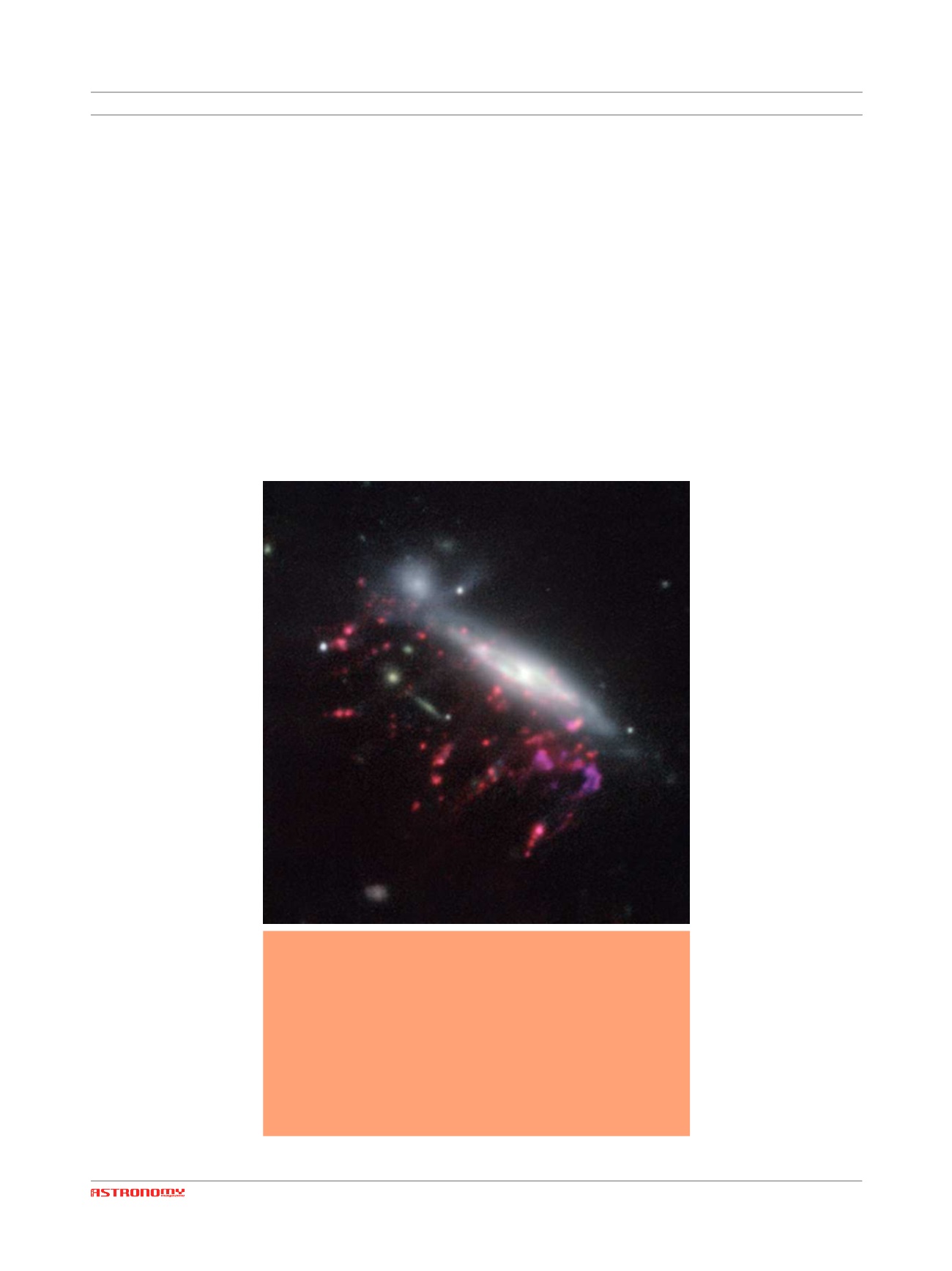
scope in Chile, show clearly how material is streaming out of the
galaxy in long tendrils. Red shows the glow from ionised hydro-
gen gas and the whiter regions are where most of the stars in
the galaxy are located. [ESO/GASP collaboration]
Galaxy JO204