


 12 / 52

12
SEPTEMBER-OCTOBER 2017
SPACE CHRONICLES
our own solar system.” Reporting in
the journal
Nature
, scientists used
data from NASA’s Hubble Space Tele-
scope to study WASP-121b, a type of
exoplanet called a “hot Jupiter.” Its
mass is 1.2 times that of Jupiter, and
its radius is about 1.9 times Jupiter’s
— making it puffier. But while
Jupiter revolves around our Sun once
every 12 years, WASP-121b has an
orbital period of just 1.3 days. This
exoplanet is so close to its star that
if it got any closer, the star’s gravity
would start ripping it apart. It also
means that the top of the planet’s at-
mosphere is heated to a blazing
4,600 degrees Fahrenheit (2,500 de-
grees Celsius), hot enough to boil
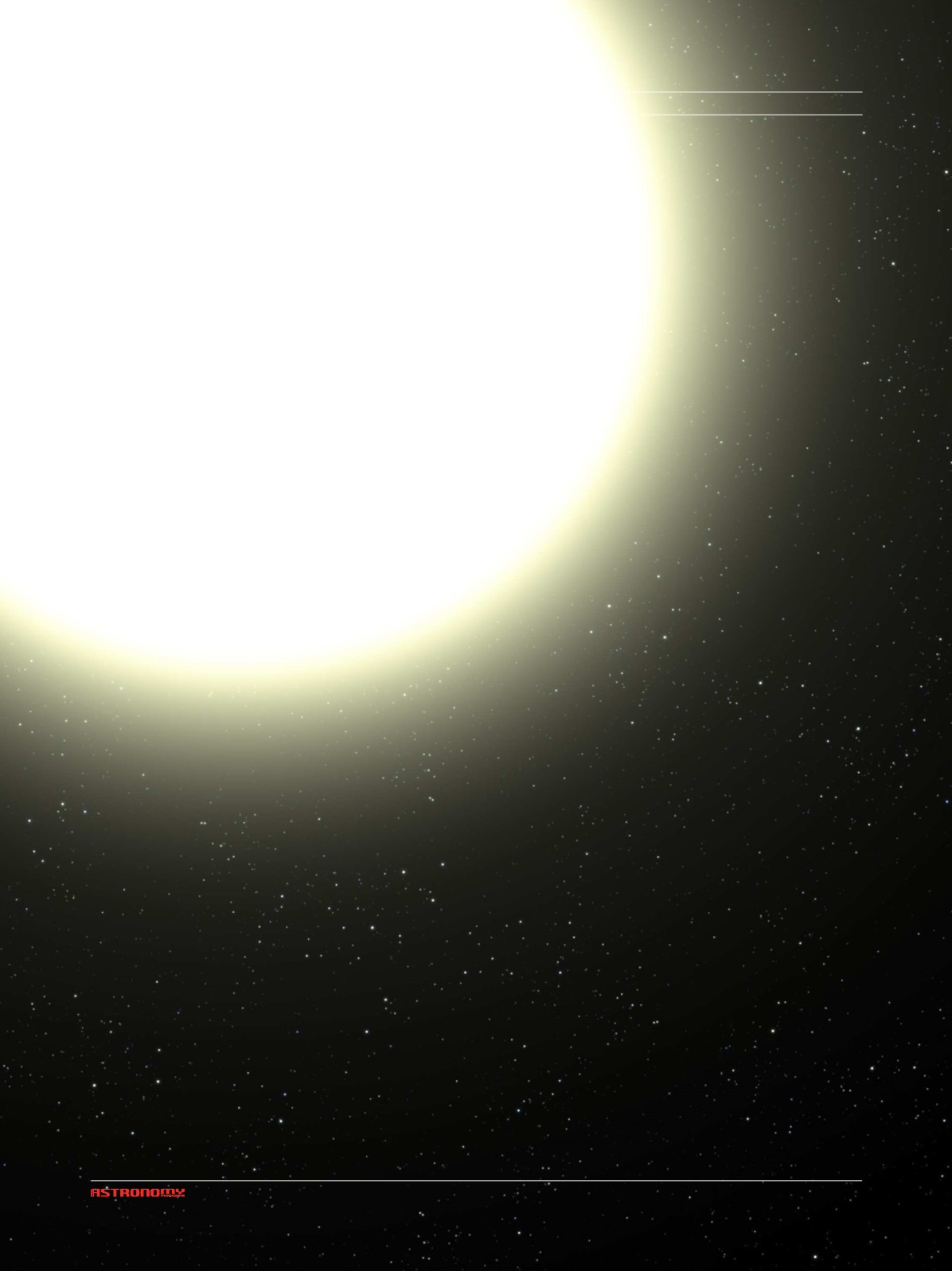
some metals. The WASP-121 system
Exoplanet with
glowing water
atmosphere
detected
by NASA/ESA
S
cientists have discovered the
strongest evidence to date for a
stratosphere on a planet out-
side our solar system, or exoplanet.
A stratosphere is a layer of atmo-
sphere in which temperature in-
creases with higher altitudes.
“This result is exciting because it
shows that a common trait of most
of the atmospheres in our solar sys-
tem — a warm stratosphere — also
can be found in exoplanet atmo-
spheres,”
said Mark Marley, study
co-author based at NASA’s Ames Re-
search Center in California’s Silicon
Valley. “We can now compare pro-
cesses in exoplanet atmospheres
with the same processes that happen
under different sets of conditions in
is estimated to be about 900 light-
years from Earth — a long way, but
close by galactic standards. Pre-
vious research found possible signs
of a stratosphere on the exoplanet
WASP-33b as well as some other hot
Jupiters. The new study presents the
best evidence yet because of the sig-
nature of hot water molecules that
researchers observed for the first
time.
“Theoretical models have sug-
gested stratospheres may define a
distinct class of ultra-hot planets,
with important implications for their
atmospheric physics and chemistry,”
said Tom Evans, lead author and re-
search fellow at the University of Ex-
eter, United Kingdom.
“Our obser-
vations support this picture.”