


 33 / 52

SEPTEMBER-OCTOBER 2017
I
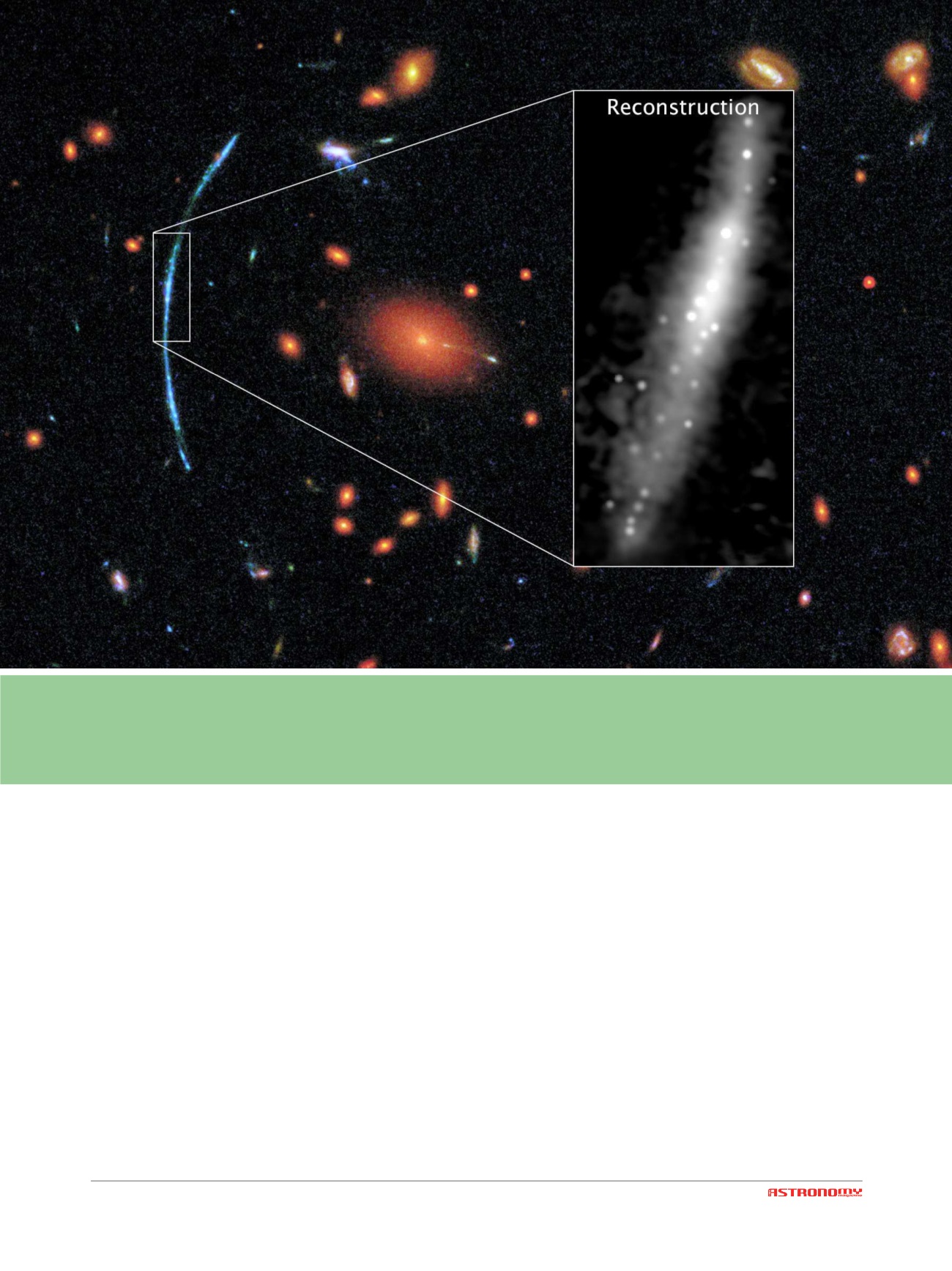
n this Hubble photograph of a distant galaxy cluster, a spotty blue arc stands out dramatically against a background of red galaxies. That arc is
actually three separate images of the same background galaxy. The background galaxy has been gravitationally lensed, its light magnified and
distorted by the intervening galaxy cluster. By using the magnifying power of this natural cosmic lens, astronomers have been able to study the
background galaxy in intimate detail. Through sophisticated computer processing, they determined how the galaxy’s image has been warped
by gravity. The image at right shows how the galaxy would look to Hubble without distortions. It reveals a disk galaxy containing clumps of star
formation that each span about 200 to 300 light-years. [NASA, ESA, and T. Johnson (University of Michigan)]
The galaxy in question is so far away
that we see it as it appeared 11 bil-
lion years ago, only 2.7 billion years
after the Big Bang. It is one of more
than 70 strongly lensed galaxies
studied by the Hubble Space Tele-
scope, following up targets select-
ed by the Sloan Giant Arcs Sur-
vey, which discovered hundreds of
strongly lensed galaxies by searching
Sloan Digital Sky Survey imaging
data covering one-fourth of the sky.
The gravity of a giant cluster of gal-
axies between the target galaxy and
Earth distorts the more distant gal-
axy’s light, stretching it into an arc
and also magnifying it almost 30
times. The team had to develop spe-
cial computer code to remove the
distortions caused by the gravita-
tional lens, and reveal the disk gal-
axy as it would normally appear.
The resulting reconstructed image
revealed two dozen clumps of new-
born stars, each spanning about 200
to 300 light-years. This contradicted
theories suggesting that star-form-
ing regions in the distant, early uni-
verse were much larger, 3,000 light-
years or more in size.
“There are star-forming knots as far
down in size as we can see,”
said
doctoral student Traci Johnson of
the University of Michigan, lead au-
thor of two of the three papers de-
scribing the research.
Without the magnification boost of
the gravitational lens, Johnson add-
ed, the disk galaxy would appear
perfectly smooth and unremarkable
to Hubble. This would give astron-
omers a very different picture of
where stars are forming.
While Hubble highlighted new stars
within the lensed galaxy, NASA’s
James Webb Space Telescope will
uncover older, redder stars that
formed even earlier in the galaxy’s
history. It will also peer through any
obscuring dust within the galaxy.
“With the Webb Telescope, we’ll be
able to tell you what happened in
this galaxy in the past, and what we
missed with Hubble because of
dust,”
said Rigby.
These findings appear in a paper
published in
The Astrophysical Jour-
nal Letters
, and two additional pa-
pers published in
The Astrophysical
Journal
.
!